Wednesday, October 29, 2008

Kegerator woes

Kicked my keg of amber last night. That means I have exactly one out of four taps up right now on the kegerator. How embarrassing. I do have some oatmeal stout in the primary that fermented like crazy (almost done after three days) and should be ready to tap in about a week. Also a lager in the secondary, but that's at least three weeks away. I think it's time to brew a quick bitter or mild - something that will be ready to drink within a week of the next brew day.

Much like our sagging economy, we have to really examine the root causes of these horrible problems in order to ensure that we do not repeat them. Why so little beer on tap? Well, I typically brew once every two or three weeks. And in the last six months (say, ten brews) four have basically been giveaways. Two for the wedding, one for DC's, and one for Brewtopia this Friday. That's forty percent of my recent beer not getting tapped up on the kegerator and being given away.

What does that mean for you, loyal reader? No more free rides. So be there at Brewtopia on Friday night, stop by the NYCHG table, and get while the gettin's good. My American Red will be on tap.

Monday, October 27, 2008

Brewed an oatmeal stout on Saturday

Thinking about the sorry state of affairs that is my kegerator (one out of four taps up now... yeesh) this weekend, it was time for another brew. With the weather cooling off I decided that it was time to whip up another batch of oatmeal stout. This is a recipe that I've been tweaking and playing with the last few years and haven't brewed it in a while. It will make its triumphant return shortly. The details:

9.5 lbs Briess organic 2-row
1.5 lbs flaked oats (half of which were toasted in the oven at 300° for 10 minutes)
1 lb Simpsons chocolate malt
.75 lb Franco-Belges kiln coffee
.25 lb Muntons crystal
2 oz Simpsons roasted barley

4 g baking soda added to mash to increase carbonates and raise mash pH

Mashed at a 3:1 liquor:grist ratio for 1 hour at 146°. Pitched boiling water to mash out at 168°, recirculated until clear, sparged, and collected 6.75 gallons wort at 1.048 OG. Boiled for an hour and 20 minutes. I had only a bittering hop addition at the start of the boil (no flavor or aroma additions). It was basically franken-hopped - I used whatever partial bags I had left over to get me up to about 25IBU (Target, Northern Brewer, Willamette). Whirlfloc tab added with 15 minutes left in the boil.

Had some trouble cooling the wort. I bought one of these gizmos and decided to use it for the first time and it totally screwed me up. It backed chill water into the carboy and sprayed water all over the kitchen, so I lost time and had to resanitze the carboy and clean up the kitchen. I was able to get it down to the mid-70's, pitch about 500ml of three week old Cal Ale yeast slurry, and give it a minute of O2. Put it in the fermentation fridge at 68°.

I really thought that the three week old slurry would give me some trouble getting started, but it took off like crazy. The next morning I had a huge blowoff mess to clean up. I probably lost a half gallon of beer, which is a pretty big bummer.

Oh, and I made an electric heat stick to help me get up to a boil faster and achieve a more vigorous boil. Used it for the first time in this brew, and let's just say that this thing rocks. I'll post more on that project later in the week.

In other weekend news, went to Grimaldi's again with R on Saturday before brewing. Nothing like the best coal oven pizza in the world and a Climax IPA to get a brewer revved up for his day. And big win for the G-Men yesterday.

Tuesday, October 21, 2008

Chili and Beer at the Newark Museum

I came across an article in one of the beer rags about a chili and beer tasting event at the Newark Museum on Thursday (10/23). It's a shame that there hasn't been more publicity about it, it sounds kind of cool. R and I will try to make it over there, but that's not set in stone yet. It starts at 6PM which may be a bit too early for us, especially considering that it will be over at 8:30. $50 is kind of steep for a 2 1/2 hour event, but the money is going to a pretty good cause. Tickets will be available at the door and there's plenty of parking right on site.

Thursday, October 16, 2008

Counting yeast

So, as promised, here's some detail on my yeast counting adventure the other night...

I ordered a smack pack of the Wyeast Danish Lager yeast about two months ago. I knew that I'd need to build up a starter in order to have enough healthy yeast to pitch into my 5.5 gallons of 1.054 wort. So, about four days before brew day I made a starter:

3.5 liters of 10˚ Plato wort boiled with 1/2 tsp. of yeast nutrient. Cooled it to room temperature, pitched the smack pack, and set it on the stir plate to ferment out and build up the yeast count. Once fermentation was finished, I crashed it to about 32˚ until brew day. Decanted the "beer" off the top of the yeast slurry (by siphoning, not pouring) and was left with about 300ml of yeast slurry to pitch into my wort.

Here's everything needed to do the job:
  1. 4000ml erlenmeyer flask - I have 1000ml and 2000ml flasks, but they just don't do the job. No room for enough wort to build big yeast counts, and more importantly, not enough room for krausen. Had too many overflow problems with the smaller flasks.
  2. 10˚ Plato Wort - I take my last runnings from brew day and boil them down to about 10˚ brix on the refractometer (brix/Plato, close enough). I then fill up mason jars with the near-boiling wort, cap, bring them down to room temp, then refrigerate until needed.
  3. Yeast nutrient - the yeast nutrient gets boiled for about 10 minutes in the flask with the wort to sanitze before making the starter.
  4. Foam stopper - these dudes are great. I get them from Northern Brewer, and they're perfect for yeast starters. easier than doing an airlock because I can keep it in the flask while I boil and sterilize the whole bit.
  5. Stir bar - I've used a few different sizes and seem to have the best luck with the smaller ones. They don't get as much of a vortex in the flask, but they don't get thrown nearly as often as the larger ones. Throw it in the boiling starter wort shortly before it's finished to sanitize it.
  6. DIY stir plate - the standard CPU fan and magnet project.
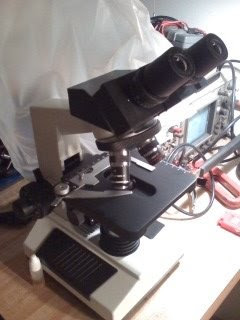
So on brew day I wanted to know about how much yeast was in that 300ml or so of slurry. How? Gotta count it on a hemocytometer under a microscope. Not exactly the easiest thing for most folks to do in their basement or garage or spare bedroom, but when you take a hobby too far....

Equipment:
  1. 10ml pipette
  2. Pipette pump (10ml)
  3. (2) 100ml graduated cylinders
  4. Hemocytometer and slide cover
  5. Methylene blue dye
  6. Microscope
I filled each of the 100ml cylinders to 90ml with distilled water. Used the pipette and pump to take a 10ml sample from the yeast slurry and add it to one of the cylinders. Now I had a 10:1 dillution of slurry. Then I took 10ml from that cylinder and added it to the other one. Now I had a 100:1 dillution - this makes it easier to count.

The theory behind the hemocytometer is that it has a 0.0001 cubic mm chamber that you can view under a microscope and count the amount of stuff that's in there. Usually blood or sperms, but brewers use them to count yeast cells. So try not to get yourself a used hemocytometer.

I added a drop of methylene blue stain to the cylinder (more on that later), used a dropper to take a sample from it, put it on the hemocytometer, and put the slide cover on. Then I viewed it under the microscope to count the cells at 400X magnification.

The 0.0001 cubic mm hemocytometer chamber is divided up into a five by five grid. You could count what you've got in all 25 boxes, but that's a lot of work. Standard practice is to count five of the boxes - the four corners and the one in the middle.
So I counted the yeast cells in five of the boxes. (My hemocytometer has two 0.0001 cubic mm chambers, so I counted both.) I counted 239 in one and 286 in the other. So now how do we figure out how much yeast is in the slurry? Multiply the cell count (239 or 286) by the proportion of boxes counted (5:1) by the dillution factor (100:1) and divide by the hemocytometer chamber volume (0.0001 cubic mm = 0.0001 ml).

(239cells*5*100)/0.0001ml = 1,195,000,000 cells/ml

or

1.195x10^9 cells/ml

or

1.430x10^9 cells/ml for the second chamber counted with 286 cells

Now, the rule of thumb is that you're supposed to pitch 1,000,000 (1.0x10^6) cells per ml of 1˚ Plato of wort. I had 5.5 gallons of 13.0˚ brix wort. 5.5 gallons = 2.08x10^4ml, and we can assume that 13.0 brix = 13.0 Plato. So I needed:

13.0˚ x (1.0x10^6 cells per ml/1˚) = 1.3x10^7 cells/ml

2.08x10^4ml * 1.3x10^7 cells/ml = 2.7x10^11 cells

So how much of my yeast slurry would give me 2.7x10^11 cells?

2.7x10^11 cells / 1.195x10^9 cells/ml = 226 ml

or

2.7x10^11 cells / 1.430x10^9 cells/ml = 189 ml

Hope you love math. Oh, and what about that methylene blue stain? The idea is that healthy yeast will reject it, and dead yeast will be stained blue under the microscope. I don't know if I didn't add enough dye or what, but I couldn't see any stained cells. So I skipped that part of the exercise.

And how exactly is this supposed to help me when my erlenmeyer flask only has 500ml marks? Not much. I guesstimated about 300ml of slurry in the flask, but it easily could have been 200. Or 250. Or 350. And then what about my 5.5 gallons of wort? That could have easily been 5.25, which would throw my calculations off by about 5%.

So what's a poor homebrewer to do? Just pitch the whole damn slurry! RDWHAHB!

Monday, October 13, 2008

Weekend brew

Busy weekend. Friday night, met R in Hoboken and did a bit of bar hopping. Nothing too exciting on the beer front - Old Scratch Amber, Rowhouse Red, and Reissdorf Kolsch at Mile Square (yes, corny, I know), Radeberger Pils at L&J's, Flying Fish ESB and about the most disgusting pint of Pilsner Urquell I've ever had at the 8th Street Tavern. They also served up about the worst plate of nachos we've ever had. Not even ballpark quality.

Finished up Friday night at the Malibu Diner. Nothing like dumping disco fries and a taylor ham, bacon, egg, and cheese on a roll on top of all that beer. I'm surprised I'm still alive.

Saturday was brew day. I went back to work on tweaking my lager recipe:

10 lbs Weyermann Bohemian Pilsner (would have preferred an American lager malt, but this was all I could get at the LHBS)
1.5 lbs Weyermann Light Munich
2 oz. Briess Carapils

Shot for a 122° protein rest, but missed it and hit 126° (for 30 minutes). No big deal. Mashed at 148° at a 3:1 l:g ratio. Wound up with a two hour mash, due to trouble cleaning the wort chiller. Again, no big deal. Mashed out at 168°, recirculated until clear, sparged, and collected 7 gallons wort. Boiled down to 5.75 gallons at 1.054. Added 5g Gypsum to the boil since the pH read a bit high. Oh, hops:

1 oz Polish Marynka pellets 6.5% AA boiled 90 minutes
5g Sterling whole hops 7.0%AA added with 20 minutes remaining
5g Sterling whole hops 7.0%AA added with 15 minutes remaining
5g Sterling whole hops 7.0%AA added with 5 minutes remaining
5g Sterling whole hops 7.0%AA added at flame-out

Added whirlfloc tab with 15 minutes remaining, and 1/2tsp rehydrated yeast nutrient with 10 minutes remaining. Chilled and collected 5.5 gallons at about 66°. Cooled the wort overnight down to 54°, pitched about 300ml Carlsberg yeast from a starter, oxygenated and continued cooling the wort. Had active fermentation at 49° within 24 hours of collecting wort.

The Carlsberg yeast is Wyeast Danish Lager, I believe. This is my first time using it. It seems to have formed a weird looking mass at the top of the carboy. Always interesting to see how a new yeast performs. Also, I counted cells with a hemocytometer and microscope. I'll post more on that later...

Went to Krogh's in Sparta on Sunday afternoon. Had the two seasonal beers - Lindfor's Lager, a Czech style pilsner, and their Oktoberfest. The lager was malty with a pleasant hop nose, though a touch too bitter for me. The Oktoberfest was a deep amber, rich and malty, though there was a slight sulfury note that was a minor distraction. All was forgiven with some rarebit sauce.

Friday, October 10, 2008

HB Oktoberfest at Hop Devil

See below...

Stopped in there last night to sample this very intriguing beer. A bit disappointing in that it wasn't truly a wood beer, as the description made it sound. The cask was wood covered, but definitely lined either with plastic or stainless - no wood character in the beer at all. You could even tell by the seams in the faux hoops, that it was really just a show piece and not a "real" barrel at all.

The beer itself was good. A true German lager, just as you'd expect from HB. Not really an Oktoberfest beer, more like a milder pilsner. Had a fragrant noble hop nose and malt sweetness, but restrained hop bitterness.

On the homebrew front...

Got my 3.5 liter lager yeast starter going. I'm going to use the Carlsberg yeast for my next lager - the granddaddy of all lager yeasts. Unfortunately it got started very slowly, so I don't know if it will be ready for a Saturday brew. If not, I've got an ale yeast slurry ready and it will be Oatmeal Stout time.